Spot, Curve and Bid-Ask: the three DLMM strategies
Spot, Curve and Bid-Ask explained with pictures: how each shape spreads your liquidity, when to use it, the risks, and how to pick one on MeteMate.
- Spot spreads liquidity evenly — the safe, all-round default.
- Curve piles liquidity near the current price — most fees in calm, sideways markets.
- Bid-Ask piles liquidity at the edges — built for volatile moves and for buying dips / selling pumps.
- The shape changes how fast your position converts as price moves.
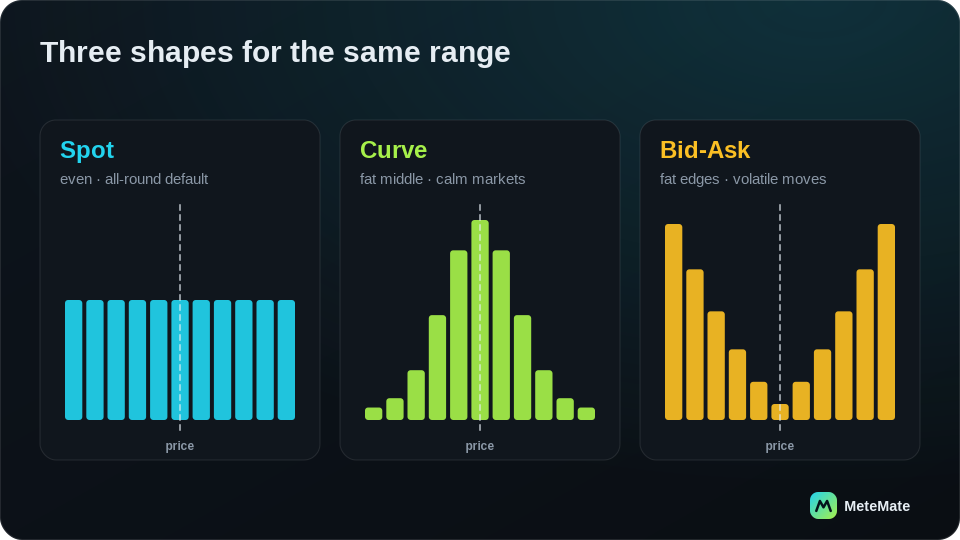
When you add liquidity to a DLMM pool you choose not only where your money goes (the range) but also how much goes into each bin. Meteora offers three shapes. Each one is a different bet on how price will behave.
Spot — the even spread
Every bin gets the same amount. It is simple and forgiving: whether price drifts up or down, your liquidity converts at a steady pace.
- Use it when you are new, or you have no strong view on where price goes.
- Watch out — liquidity at the far edges earns little most of the time.
Curve — fat in the middle
Most liquidity sits around the current price, thinning out towards the edges. While price chops sideways, you capture the most fees per dollar.
- Use it when the pair is calm or ranging, like SOL/USDC on a quiet day or a token that has settled.
- Watch out — a strong move quickly converts the big middle chunk, and you go out of range faster in effect.
Bid-Ask — fat at the edges
Little liquidity near the price, lots at the ends. It behaves like a ladder of limit orders: as price drops, you buy more and more; as it rises, you sell more and more.
- Use it when the token is volatile, you expect big swings, or you want to accumulate on dips (SOL-only below price) or take profit on pumps (token-only above price).
- Watch out — you earn less in calm markets, because little liquidity sits where the trading is.
Which one should I pick?
| Market looks… | Try |
|---|---|
| Calm, sideways | Curve |
| Not sure | Spot |
| Wild, big candles | Bid-Ask, wider range |
| Want to buy the dip with SOL | Bid-Ask, SOL only, below price |
| Want to sell into a pump | Bid-Ask, token only, above price |
Range width matters as much as shape
A narrow range is a stronger bet: more fees while it holds, faster exit when it breaks. A wide range is calmer. For a new memecoin with 100 bps bins, many LPs start with a range several tens of percent wide. For SOL/USDC, a few percent can be plenty.
✅ Quick check
1. Which shape puts most liquidity near the current price?
2. You want to slowly buy a token with SOL if it dips. Which setup fits?
3. The market is choppy and you have no strong view. A safe start is…
Questions people ask
What is the best DLMM strategy for beginners?
Spot. It spreads liquidity evenly over your range, converts at a steady pace and is the most forgiving if your price guess is wrong.
When should I use Bid-Ask in Meteora DLMM?
Use Bid-Ask for volatile tokens or when you want to buy dips or sell pumps, because it places most liquidity at the edges of your range like a ladder of limit orders.
Is Curve better than Spot?
Curve earns more per dollar while price stays near the middle of your range, but it converts faster on strong moves. It suits calm, sideways markets.