How Meteora DLMM works: bins, bin step and the active bin
Understand Meteora DLMM in minutes: what bins are, how bin step sets the price gap, why only the active bin earns, and how to pick a price range.
- A DLMM pool splits the price line into small steps called bins.
- Each bin holds liquidity at one fixed price. Trades happen in the active bin.
- Bin step is the price gap between bins: 100 bps = 1% per bin.
- You choose which bins to fill. Tight range = more fees per dollar, more risk of going out of range.
Classic pools spread your money across every possible price, from almost zero to infinity. Most of it never gets used. Meteora's DLMM does it differently: it cuts the price line into little steps and lets you put your money only where trading actually happens.
Bins: the price line as a staircase
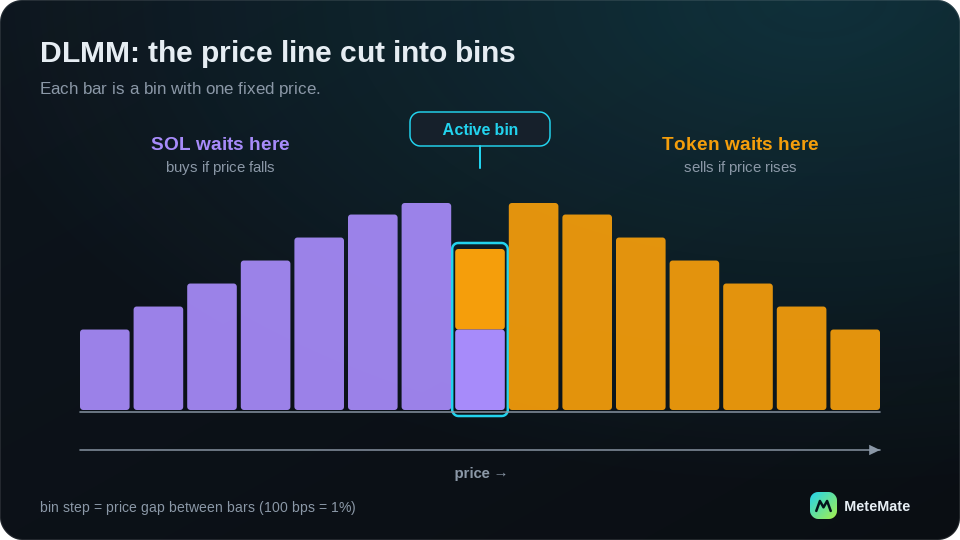
Picture the price of a token as a staircase. Each stair is a bin. Every bin has exactly one price. If a bin is at $0.0100, every swap inside that bin happens at $0.0100 — no slippage inside the bin.
The active bin
At any moment one bin is the active bin — the one that contains the current price. When traders buy, they take the token out of the active bin. Once it is empty, the price moves up one bin and the next bin becomes active. Selling does the opposite.
That gives a simple rule worth remembering:
- Bins below the current price hold SOL (or the quote token). They are waiting to buy the token if price falls.
- Bins above the current price hold the token. They are waiting to sell it if price rises.
- Only bins that trades pass through earn fees. Liquidity sitting far from the price earns nothing until price gets there.
Bin step: how big each stair is
The bin step is the price gap between two neighbouring bins, measured in basis points (bps). 1 bps = 0.01%.
| Bin step | Gap per bin | Typical use |
|---|---|---|
| 1–10 bps | 0.01–0.1% | Stablecoins, very calm pairs |
| 20–80 bps | 0.2–0.8% | SOL, majors, established tokens |
| 100–400 bps | 1–4% | New and volatile memecoins |
A bigger bin step covers more price with the same number of bins. 69 bins centred on the price reach from about −29% to +41% in a 100 bps pool, but only about −3.4% to +3.5% in a 10 bps pool.
Your position: a range of bins
When you add liquidity you pick a lower and an upper price. Your money is spread over every bin in between, using a shape you choose (Spot, Curve or Bid-Ask — see strategies).
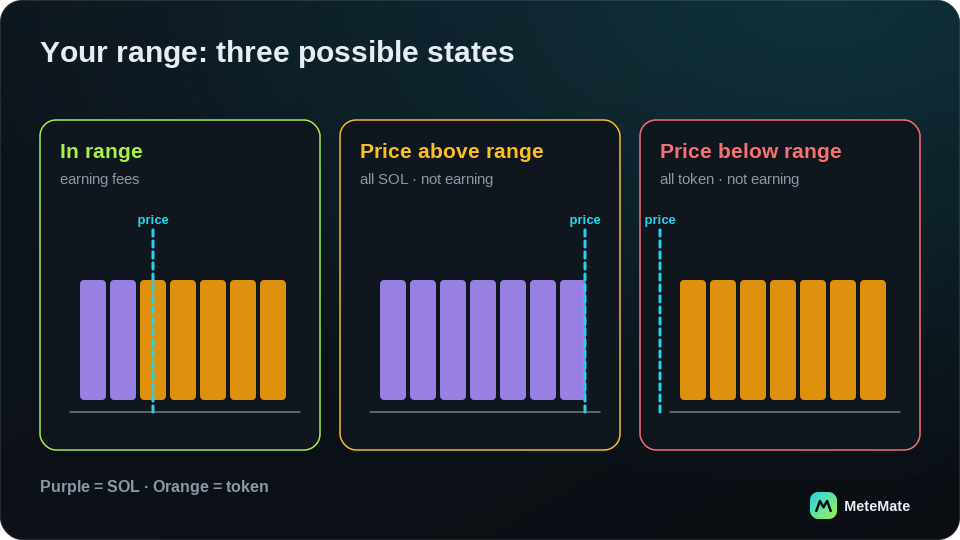
- In range — price is inside your bins. You earn fees on every trade.
- Out of range above — price rose past your top bin. All your tokens were sold for SOL. You stop earning, but you hold SOL.
- Out of range below — price fell below your lowest bin. All your SOL was used to buy the token. You stop earning and you hold the token.
Why the fee can change: dynamic fees
DLMM pools add a variable fee on top of the base fee when the market gets wild. When price jumps across many bins quickly, the fee rises, so LPs get paid more for the extra risk. When things calm down, it falls back. On MeteMate you will see both, e.g. "Fee 1.50% + 2.64%".
Quick summary
Bins are price steps, the active bin is where trades happen, bin step sets the gap, and your range decides when you earn. Get those four ideas and the rest of DLMM is details.
Open any DLMM pool and look at the liquidity chart — each bar is a bin.
Explore DLMM pools →✅ Quick check
1. The price is in the middle of your range. What do the bins below the price hold?
2. A pool has a bin step of 50. How far apart are two neighbouring bins?
3. Price shoots above your top bin. What do you hold now?
Questions people ask
What is a bin in Meteora DLMM?
A bin is a small price step that holds liquidity at one fixed price. Trades happen in the active bin, and when it runs out the price moves to the next bin.
What does bin step mean?
Bin step is the price difference between neighbouring bins in basis points. A bin step of 100 means each bin is 1% above the previous one.
Do I earn fees when my DLMM position is out of range?
No. You only earn fees on trades that pass through your bins. Out of range, your liquidity sits as one token and earns nothing until price comes back.
Which bin step should I choose?
Small bin steps (1–10) suit stable pairs, 20–80 suit SOL and established tokens, and 100 or more suits volatile new tokens because each bin covers a bigger price move.