How LP fees work: base fee, dynamic fee and fee/TVL
Learn how Meteora liquidity providers earn: base fee, dynamic fee, why fee/TVL beats APR for comparing pools, and a worked example of daily fee income.
- Fee earned ≈ volume through your bins × fee %. Busy pools pay more.
- Base fee is fixed per pool; the dynamic fee rises with volatility.
- Use 24h fee/TVL to compare pools; APR shown on new pools is often misleading.
- Fees you see are not profit until you subtract price movement.
Fees are the reason LPs exist. Understanding where they come from helps you pick pools that actually pay, instead of pools that only look good on a screenshot.
The fee formula, roughly
Your fees ≈ volume that passes through your liquidity × pool fee × your share of that liquidity
So three things matter: how much is traded, how high the fee is, and how much of the liquidity at that price is yours.
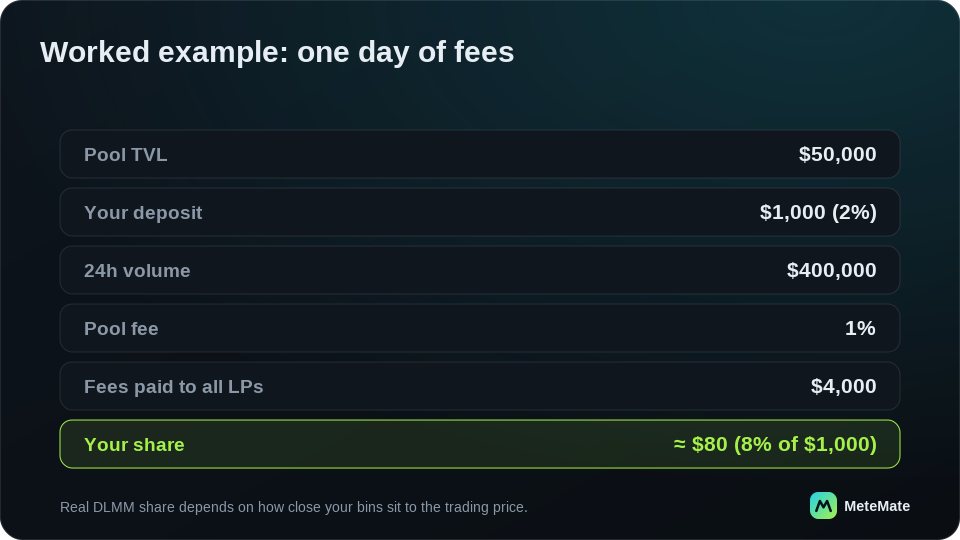
A worked example
- Pool TVL: $50,000. Your deposit: $1,000 (2% of the pool).
- 24h volume: $400,000. Fee: 1%.
- Total fees paid that day: $400,000 × 1% = $4,000.
- Your share if your liquidity is used like everyone else's: 2% × $4,000 = $80.
That is 8% in a day. In DLMM your real share depends on where your bins are — liquidity right at the active price earns more than liquidity far away.
Base fee vs dynamic fee
The base fee is set when the pool is created and does not change (except for scheduled DAMM v2 pools). The dynamic fee is added when price moves fast, then decays as the market calms. On MeteMate both are shown: "Fee 1.50% + 2.64%" means a 1.5% base fee plus 2.64% dynamic fee at this moment.
Why fee/TVL beats APR
A pool that is ten minutes old with one big trade can show an APR of 50,000%. That number just multiplies a tiny moment by a whole year. 24h fee/TVL is more honest: what did this pool really pay, relative to its size, in the last day? Compare pools by fee/TVL and by volume trend, not by headline APR.
Claiming fees
DLMM fees build up inside your position. You can claim them at any time from My Pools or the pool page, or they are claimed automatically when you close the position. Claiming costs a small network fee, so there is no need to claim every hour.
✅ Quick check
1. $200,000 volume, 2% fee, you own 5% of the active liquidity. Roughly what do you earn?
2. "Fee 1% + 3%" on a pool means…
3. Which number is best for comparing pools?
Questions people ask
How are Meteora LP fees calculated?
Each swap pays the pool fee (base fee plus any dynamic fee). That fee is shared among the liquidity providers whose bins the trade used, in proportion to their liquidity in those bins.
What is a good fee/TVL ratio?
It depends on risk. For new memecoin pools, LPs often look for several percent per day. For SOL or stable pairs, much smaller daily numbers are normal. Always weigh fee/TVL against how far the price could fall.
Why is the APR so high on new pools?
APR extrapolates a short period to a full year. A few big trades in a new pool can show a huge APR that will not last. Use 24h fee/TVL instead.