What is liquidity providing? A plain-English guide
Liquidity providing explained simply: how LPs earn trading fees on Solana, what a pool is, where the risks are and how to start safely with MeteMate.
- A liquidity pool is a shared pot of two tokens that traders swap against.
- You add tokens to the pot and earn a cut of every trade that uses your liquidity.
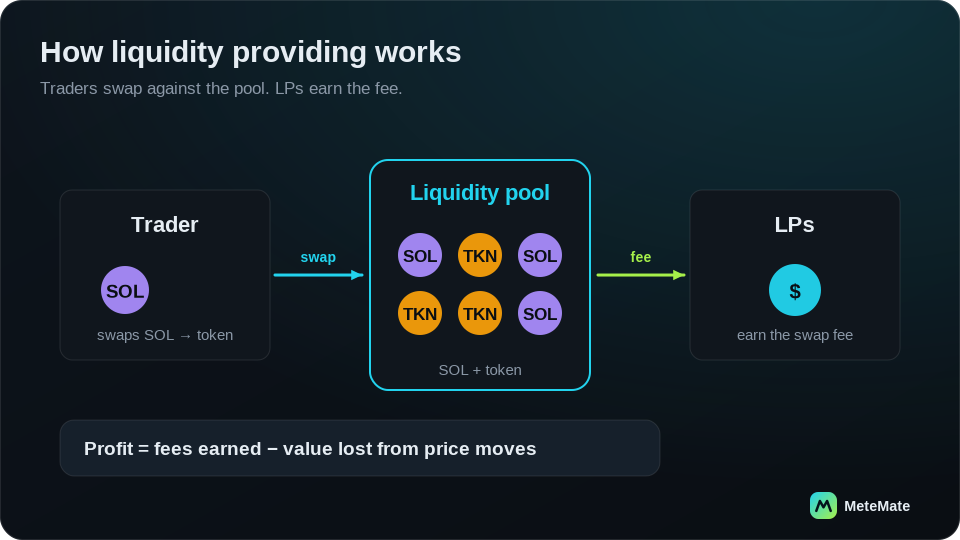
- Your profit = fees earned − any value lost because prices moved.
- Meteora has two pool types you will use most: DLMM (you pick a price range) and DAMM v2 (simpler, wider).
Every time someone swaps SOL for a token on Solana, the other side of that swap has to come from somewhere. On a decentralised exchange there is no order book full of market makers. Instead there is a liquidity pool: a smart contract that holds two tokens, for example BONK and SOL.
A trader drops SOL into the pool and takes BONK out. The pool charges a small fee for that, and the fee is paid to the people who supplied the tokens. Those people are liquidity providers, or LPs. When you provide liquidity, you become the shop that traders buy from.
Why would anyone do this?
Because fees add up. A busy new memecoin pool can trade its whole size several times in a single day. If a pool charges 2% per trade and $1 of liquidity is traded ten times, that dollar has earned around 20 cents in fees, before anything else happens. That is why LPs watch numbers like volume and fee/TVL so closely.
There is no magic, though. You are holding real tokens, and their prices move. If the token you hold crashes, the fees may not cover the drop. LPing is a trade-off between fee income and price risk, and the whole skill is managing that balance.
The three numbers to understand first
- TVL (total value locked) — how much money sits in the pool right now.
- Volume — how much was traded through the pool in a period, usually 24 hours.
- Fee/TVL — fees earned in a period divided by TVL. A 24h fee/TVL of 5% means the pool paid out roughly 5% of its size to LPs that day. It is the quickest way to compare pools.
DLMM and DAMM v2 in one sentence each
DLMM (Dynamic Liquidity Market Maker) lets you choose the exact price range where your money works. Tight range = more fees while price stays inside, but more work. Learn DLMM →
DAMM v2 is a simpler pool where your liquidity covers a wide price range, often the whole curve. Less to manage, usually fewer fees per dollar. Learn DAMM v2 →
What you need to start
- A Solana wallet such as Phantom, Solflare, Backpack or Jupiter. Set one up safely.
- Some SOL. You need SOL for the deposit itself and a little extra for network fees and refundable account rent (about 0.06–0.1 SOL per position).
- A pool you understand. Start with a pool you can explain in one sentence: what the token is, why people trade it, and what you will do if the price halves.
Browse live Meteora pools ranked by fees, volume and safety.
Open MeteMate →✅ Quick check
1. Who pays the fees that LPs earn?
2. A pool has $10,000 TVL and paid $600 in fees today. What is its 24h fee/TVL?
3. What is the main risk of LPing a new memecoin?
Questions people ask
Is liquidity providing passive income?
Not really. Fees come in automatically, but prices move and positions go out of range, so good LPs check their positions regularly. Wide DAMM v2 positions need less attention than tight DLMM ones.
How much money do I need to start LPing on Solana?
You can start with a small amount such as 0.2–0.5 SOL. Keep about 0.1 SOL extra in your wallet for network fees and refundable position rent.
Where do LP fees come from?
From traders. Every swap through the pool pays a percentage fee, and that fee is shared among the liquidity providers whose tokens were used for the swap.