Impermanent loss explained with real numbers
Impermanent loss in plain English: why LPs end up with more of the falling token, worked examples for DAMM v2 and DLMM, and five ways to keep the damage small.
- Impermanent loss (IL) is how much worse you do by LPing than by simply holding.
- It happens because the pool sells the rising token and buys the falling one.
- A 2× or ½× price move costs about 5.7% vs holding in a classic pool; a 90% crash costs much more.
- Fees can beat IL — but only if volume is high and the token does not collapse.
Here is the part most guides skip. When you LP, the pool trades your tokens for you. Traders buy from you when the token rises and sell to you when it falls. So you automatically end up with more of whatever is falling and less of whatever is rising. The difference between that and just holding is called impermanent loss, or divergence loss.
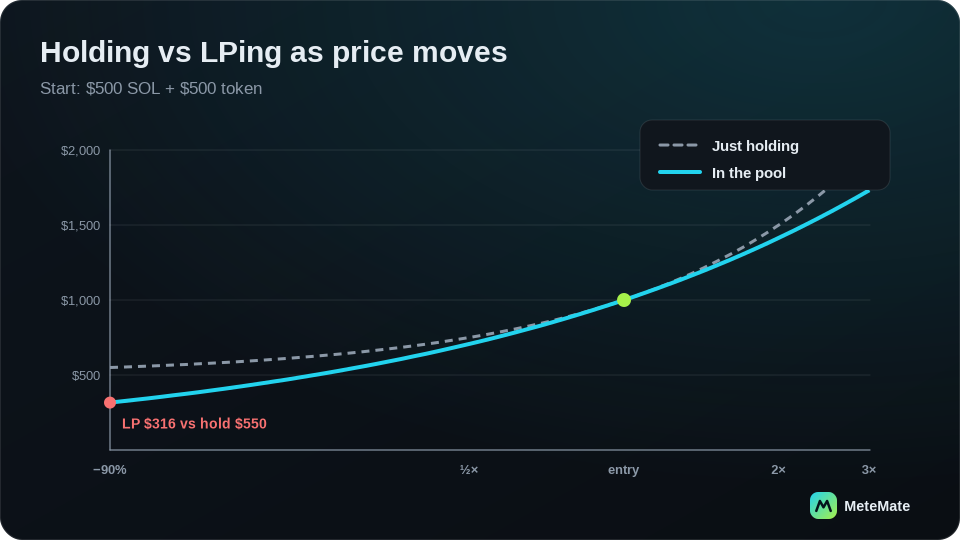
A simple example (DAMM v2 / classic pool)
You deposit $500 of SOL and $500 of a token. Total: $1,000.
| Token price move | If you just held | In the pool | IL vs holding |
|---|---|---|---|
| No change | $1,000 | $1,000 | 0% |
| 2× up | $1,500 | $1,414 | −5.7% |
| Halves | $750 | $707 | −5.7% |
| −90% | $550 | $316 | −42.5% |
Small moves hardly hurt. A crash hurts a lot, because the pool kept buying the token all the way down.
Why "impermanent"?
If the price returns to where you entered, the loss disappears, and you keep the fees. It only becomes permanent when you withdraw at a different price. With memecoins that rarely come back, treat it as a very real loss.
In DLMM it is sharper
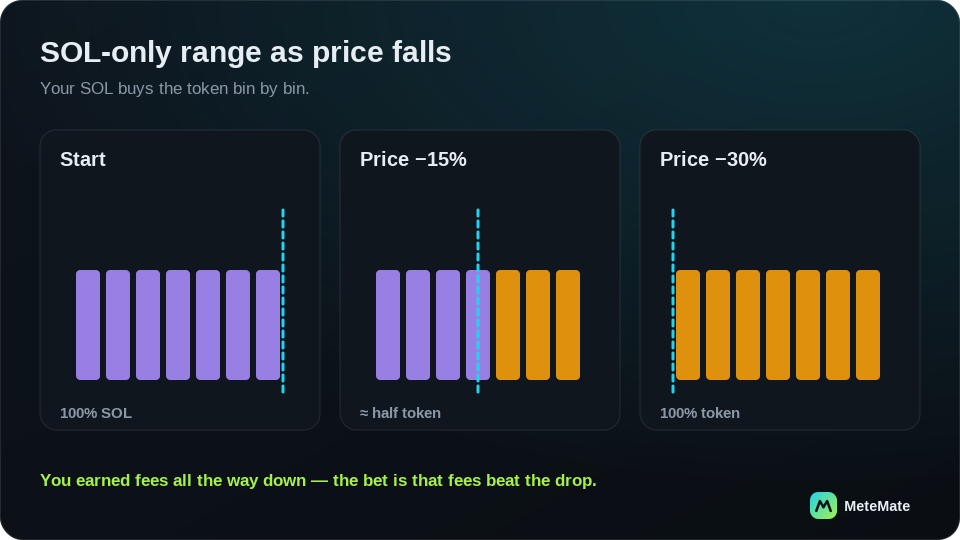
A DLMM range is concentrated, so the effect is stronger inside the range. Say you put 1 SOL in bins from −30% to the current price (SOL only). If the price falls 30% and stays there, all your SOL has been swapped into the token at an average price about 15% below where you started. You now hold the token, and you are down on it unless it bounces. You earned fees on the way down, which is the whole bet: enough fees to beat the drop.
Five ways to keep IL small
- Pick pools where fees are big relative to risk. High fee/TVL with steady volume.
- Use wider ranges on volatile tokens so a single candle does not convert your whole position.
- Use one-sided ranges deliberately. SOL below price means you are happy to buy the dip. Token above price means you are happy to sell the pump. See one-sided liquidity.
- Set an exit plan before you enter. For example: "If price leaves my range downwards and volume dies, I close."
- Track PnL including IL. MeteMate's position PnL already compares your current value plus fees against what you put in.
✅ Quick check
1. The token you LP doubles in price. Compared with holding, your classic pool position is…
2. When does impermanent loss become permanent?
3. Your SOL-only DLMM range is below price. The price falls through it. You now hold…
Questions people ask
What is impermanent loss in simple terms?
It is the difference between the value of your LP position and the value you would have if you had simply held the same tokens. It grows the further the price moves from your entry.
Can trading fees cover impermanent loss?
Yes, in busy pools fees often beat IL from normal price moves. They rarely cover a token that crashes 80–90%.
Does impermanent loss happen in DLMM?
Yes, and it is more concentrated. As price moves through your bins, your liquidity converts into the token that is losing value relative to the other.