How to find good pools on MeteMate
A step-by-step checklist for finding good Meteora DLMM and DAMM v2 pools on MeteMate: fee/TVL, volume trend, age, holders, safety score and bin step.
- Start from Find best pools — it already blends fees, volume and safety.
- Look for steady volume, not one spike. Check 5m, 1h and 6h changes.
- Fee/TVL tells you how hard the pool works; safety tells you if it is worth the risk.
- Match the bin step to how volatile the token is.
There are thousands of Meteora pools. Most are dead, many are traps and a few are great. Here is the routine that filters them down fast.
Step 1 — Start with a shortlist
Open Find best pools. MeteMate ranks pools by a blend of fee/TVL, volume, liquidity depth and safety, so empty or suspicious pools sink. The Volume tab shows pools whose volume is suddenly rising, and Degen shows the newest, riskiest launches.
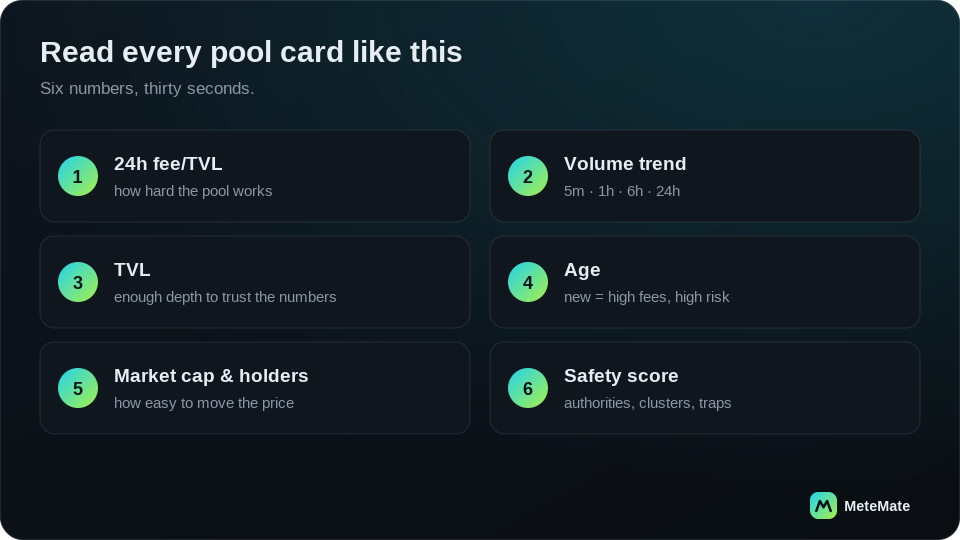
Step 2 — Read the pool card
- 24h fee/TVL — how much the pool paid relative to its size. Higher is better, but extreme numbers on tiny pools are noise.
- Volume and its trend — check the 5m, 1h, 6h and 24h changes. Rising or steady volume is what you want. Volume that peaked hours ago usually means the party is over.
- TVL — very small pools can show huge fee/TVL from a handful of trades. A bit of depth makes numbers more reliable.
- Age — brand-new pools pay the most and fail the most. Older pools with steady volume are calmer.
- Market cap and holders — a few hundred holders and a tiny market cap means a few wallets can move the price a lot.
- Safety score — MeteMate checks mint and freeze authority, holder concentration and wallet clusters. Low safety = small size or skip.
Step 3 — Pick the right pool for the token
The same token often has several pools with different bin steps and fees. Two rules of thumb:
- Volatile token? Bigger bin step (100+) so your range covers real moves.
- Where is the volume? A pool with a slightly lower fee but ten times the volume usually earns more.
Step 4 — Look at the chart
Open the pool page. Is the price chart a slow grind, a pump, or a straight dump? Is liquidity in the distribution chart stacked near the price or scattered? A token that already went up 20× in an hour is a different trade from one that is ranging.
Step 5 — Decide size and exit before you enter
Write down three things: how much you will put in, what range and strategy you will use, and what makes you leave. Then open the position.
See today's top-ranked pools with live fee/TVL and safety scores.
Find best pools →✅ Quick check
1. A pool shows a huge fee/TVL but $300 of TVL and one trade. What is it?
2. The token is very volatile. Which bin step suits it better?
3. Volume peaked 6 hours ago and is falling fast. What does that usually mean?
Questions people ask
How do I find the best Meteora pools to LP?
Start from a ranked list such as MeteMate Find best pools, then check 24h fee/TVL, volume trend, TVL, age, holders and safety score on each pool before choosing a range.
What is a good volume for a DLMM pool?
There is no fixed number. What matters is volume relative to TVL and whether it is steady or rising. Pools whose daily volume is many times their TVL pay well while it lasts.
Why are there several pools for the same token?
Anyone can create a pool with a different bin step and fee. Compare them: the pool with the most real volume at a sensible fee usually pays LPs best.