Token safety checklist: avoid rugs, honeypots and fakes
Avoid rugs before you LP: check mint and freeze authority, holder clusters, fake tickers, Token-2022 traps and dev wallets on any Solana token.
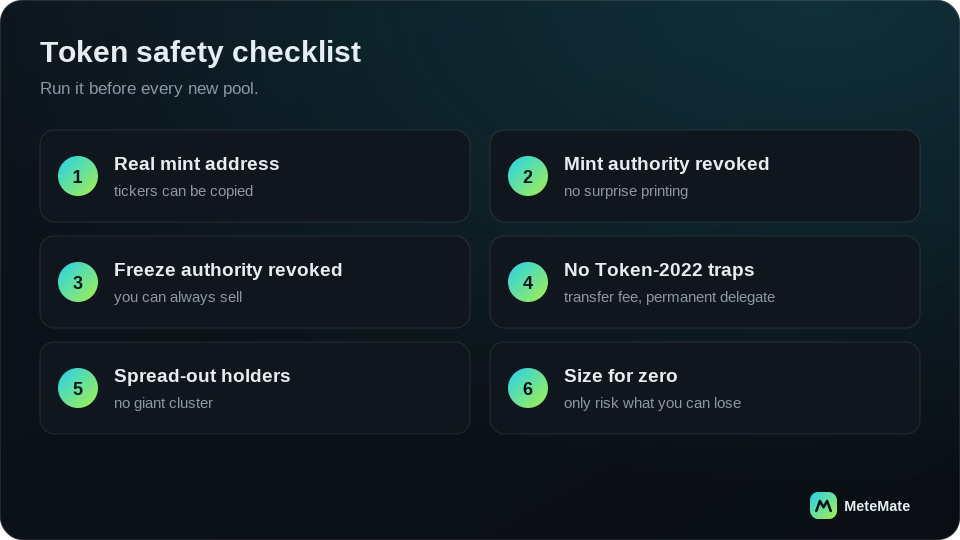
- Always check the mint address, not just the ticker — copycats are everywhere.
- Mint authority on = more tokens can be printed. Freeze authority on = you can be blocked from selling.
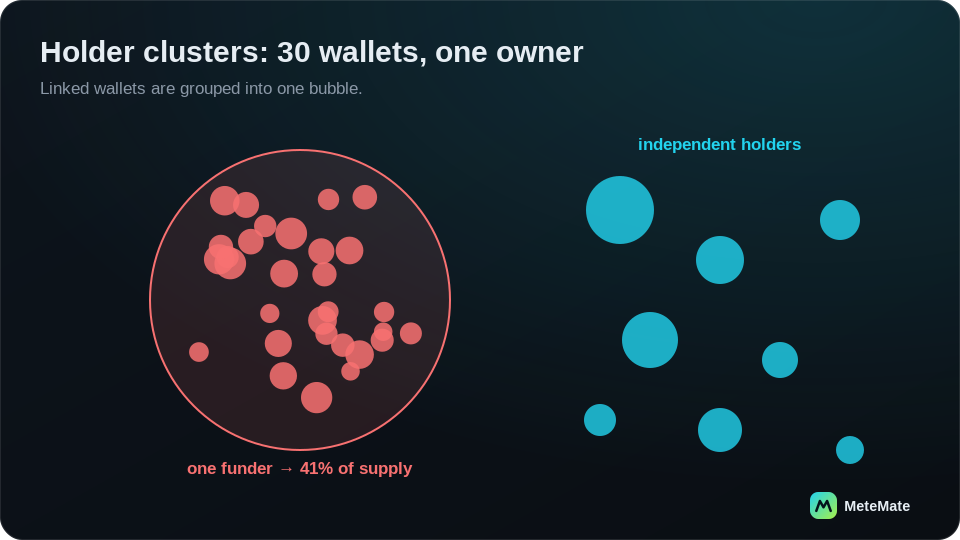
- A few wallets holding most of the supply (or one cluster of wallets) can dump on you.
- MeteMate's safety score and holder-cluster scan do most of this for you.
Fees mean nothing if the token is designed to steal from you. Run through this list before every new pool. It takes two minutes on MeteMate.
1. Is it the real token?
Anyone can create a token called the same thing as a popular coin. Check the mint address (the long contract address) against the one the project actually posts on its official account. On MeteMate you can copy it from the token page in one click.
2. Mint authority
If mint authority is still enabled, the creator can print new tokens at any time and sell them into your pool. Most legit memecoins revoke it at launch. MeteMate flags it in red.
3. Freeze authority
If freeze authority is enabled, the creator can freeze token accounts — including yours — so you cannot sell or withdraw. This is how many honeypots work. Treat it as a hard no unless it is a well-known stablecoin.
4. Token-2022 extras
Newer tokens can carry extensions. Two to watch: a transfer fee (a cut taken on every transfer, which eats your LP returns) and a permanent delegate (someone who can move tokens out of any wallet). MeteMate's Safety score counts these Token-2022 traps against the token.
5. Who holds the supply?
If the top 10 wallets (excluding pools and burn addresses) hold most of the supply, a few people can crash the price whenever they like. MeteMate's holder-cluster scan goes further: it groups wallets funded by the same source or that bought in the same block, so a dev hiding behind 30 fresh wallets shows up as one big bubble.
6. Dev and liquidity behaviour
- Did the creator sell most of their tokens in the first minutes?
- Was the original liquidity pulled?
- Is there a real community, or only bots posting the ticker?
7. Size it like it can go to zero
Even a clean token can die. The safety check tells you whether it is a scam, not whether it will go up. Size every new-token position as if losing it would be annoying, not life-changing.
✅ Quick check
1. Freeze authority is enabled on a new memecoin. What is the risk?
2. Two tokens share the same ticker. How do you know which is real?
3. 30 top holders were all funded by one wallet minutes before launch. What does that suggest?
Questions people ask
How do I check if a Solana token is safe?
Check the mint address, make sure mint and freeze authority are revoked, look for Token-2022 transfer fees or a permanent delegate, and look at holder concentration and wallet clusters. MeteMate shows all of these in its safety score.
What is freeze authority and why does it matter?
Freeze authority lets the token creator freeze token accounts so holders cannot transfer or sell. It is a common honeypot technique, so most LPs avoid tokens that keep it enabled.
What is a holder cluster?
A holder cluster is a group of wallets that appear separate but are linked, for example funded by the same wallet or buying in the same block. A big cluster means one party may control much of the supply.